


23.7K certified reviews
Longboards
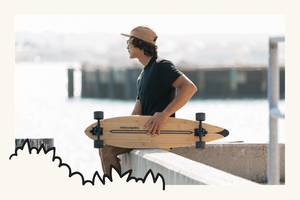
Get ready to roll with durably crafted pintails, drop down, and drop through longboards that were made for cruising in style.
Trusted By Our Loyal Customers

Free shipping over $35

Exceptional Value

Finance starting from $19/month
sort by:
Product Type:


From Our Gear Experts
What is the best skateboard style for beginners?
Many people say the longboard is the best skateboard style for beginners, because longboards are stable and easy to balance on. But it really depends on the type of skating you want to learn. If you want to learn to drop into bowls, grind rails, and hit aerial tricks like ollies, pop shuvits, and kickflips, then you should learn on a normal skateboard. If you want to bomb hills, reach high speeds, and powerslide, then a longboard is a good choice.
What is the easiest skateboard to balance on?
A longboard is the easiest skateboard to balance on. Longboard decks are longer and wider than those found on normal skateboards. Longboards also have wider trucks and larger, softer wheels. All these factors combine to make longboards significantly more stable and smoother to ride than smaller boards.
Is a longboard a skateboard?
Yes, a longboard is a type of skateboard, but with some differences in shape, size, and functionality. Longboards are longer and wider than regular skateboards, usually measuring around 40” to 50” long (or even longer) and 9” to 10” wide. They lack the defined kicktail and nose of a skateboard. Longboards also have larger, softer wheels that offer a smoother ride and better grip on rough surfaces, making longboards great for high speeds and long rides.
Should I get a longboard or a skateboard?
When it comes to choosing a longboard or skateboard, it depends on your preferences and riding style. If you're into cruising, carving, hill bombing, and a smooth ride, a longboard is a good choice. If you want to learn aerial tricks like ollies and kickflips, hit vert ramps, or drop into bowls, then a skateboard is the way to go. You can’t do much at a skatepark with a longboard.
Are skateboards or longboards better for transportation?
It depends. Longboards can reach higher speeds and are smoother and more stable, but they are significantly heavier and larger than skateboards and cruisers, making them hard to carry with you when not riding.
If you're looking at a long commute on a consistent surface (a bike path or greenway, for example), then a longboard may be a great choice. If you’re commuting in a hectic urban environment, combining your skateboard with bus or metro rides, or if you have to carry your board with you into class or work, then a lighter, more portable board like a mini cruiser is a better choice.
If you're looking at a long commute on a consistent surface (a bike path or greenway, for example), then a longboard may be a great choice. If you’re commuting in a hectic urban environment, combining your skateboard with bus or metro rides, or if you have to carry your board with you into class or work, then a lighter, more portable board like a mini cruiser is a better choice.
Are longboards flat or curved?
Classic longboard decks, like our Zed Pintail, are completely flat, without an upcurved nose or tail like a skateboard. However, there are several types of longboard decks, and a few of these do have a slight curve. Kicktails like Zed 44” have an upturned tail, allowing you to kick the board up into your hand. Dropped boards like Rift and Tidal have a concave, downward-curved shape, providing a lower center of gravity and increased stability at high speeds. Learn more about longboard decks below.
What are the types of longboard decks?
There are four main types of longboard decks: the pintail, kicktail, drop-through, and drop-down. The pintail (Zed Pintail 41”) features a leaflike shape, with a tapered nose and tail, offering stability and versatility. The pintail is generally considered the best board style for new riders. A kicktail longboard like Zed 44” is similar to a pintail, but with a slightly raised tail. This lets you “kick” your board up into your hand when you stop riding, without having to bend over and pick it up.
Drop-through and drop-down boards are similar. Both feature cutouts near the trucks, allowing for deeper carving with less risk of wheelbite (when you carve so hard that your deck hits your wheels). Drop-through boards have the trucks attached to the top of the deck, so the deck sits level with the wheels. Drop-down boards actually have a concave deck that sinks below the wheels, providing a lower center of gravity. Both these styles allow for increased carving and high speeds.
Drop-through and drop-down boards are similar. Both feature cutouts near the trucks, allowing for deeper carving with less risk of wheelbite (when you carve so hard that your deck hits your wheels). Drop-through boards have the trucks attached to the top of the deck, so the deck sits level with the wheels. Drop-down boards actually have a concave deck that sinks below the wheels, providing a lower center of gravity. Both these styles allow for increased carving and high speeds.
What size longboard should I get for my height?
When it comes to choosing the right size longboard for your height, there's no strict rule; it's more about riding style and comfort. A longer deck is a good choice for beginners seeking stability and control or for those riding long distances.
How fast do longboards go?
The vast majority of longboarders will only cruise around 10 to 20 mph. However, skilled downhill longboarders can reach incredibly high speeds, even upwards of 80 mph! Professional longboarder Pete Connolly (UK) currently holds the world speed record for longboarding. Connolly clocked a stunning 91.17 mph in 2017 at L'Ultime Descente Speed Challenge in Quebec, Canada. We do not recommend trying that at home! ;-)
What makes a longboard fast?
Longboards can reach higher speeds than skateboards because they have larger wheels. The wheel diameter on most longboards ranges from 65mm to 75mm, but it can reach up to 100mm. Wider wheels can reach higher speeds, but as wheel size (and speed) increases, acceleration decreases.
Longboards are also able to reach higher speeds due to a combination of other factors, such as wheel shape, contact patch, core, and durometer (hardness). High-quality bearings, which allow the wheels to turn faster, and deck shape and flexibility, which allow the rider to maintain stability at high speeds, also play a role.
Longboards are also able to reach higher speeds due to a combination of other factors, such as wheel shape, contact patch, core, and durometer (hardness). High-quality bearings, which allow the wheels to turn faster, and deck shape and flexibility, which allow the rider to maintain stability at high speeds, also play a role.
How tight should longboard trucks be?
There is no hard and fast rule for how tight your longboard trucks should be. It varies person-to-person, based on weight, height, skill, and the riding you’re doing. Looser trucks provide better carving ability but decrease stability. Tight trucks offer more control and reduce wobbles but limit your ability to carve.
Downhill riders prefer tight trucks to maintain control when hitting high speeds, but looser trucks are best for basic cruising. Ultimately, you just have to start riding your board and find a truck tightness that suits you. You may even use your skate tool to change your truck tightness multiple times during a ride, such as before hitting a big hill.
Downhill riders prefer tight trucks to maintain control when hitting high speeds, but looser trucks are best for basic cruising. Ultimately, you just have to start riding your board and find a truck tightness that suits you. You may even use your skate tool to change your truck tightness multiple times during a ride, such as before hitting a big hill.
How long is a longboard?
Longboard length can vary quite a bit, ranging from 33 inches to about 60 inches. Extreme downhill riders may have longer decks for increased stability at high speeds, while hybrid cruisers may be closer to 30 inches so that they can be picked up and carried easily. However, most all-purpose longboards fall between 33 and 45 inches long.
How long and wide should my longboard be?
Longboard decks can come in many shapes and sizes, but the most common range is 33 to 45 inches long and 9 to 10 inches wide. Anywhere in this range is a great choice for a basic longboard deck.
What is the goofy stance on a longboard?
All board sports, from surfing to snowboarding to skateboarding, have two stances: regular and goofy. Regular stance has the rider leading with their left foot, goofy stance is the reverse, the rider leads with their right foot. These stances correlate to something called “footedness,” the natural dominance of your right or left foot. On a longboard, your dominant foot should be in the back, as it does the pushing and steering. Your front foot—also known as the pivot foot—is your non-dominant foot.
How do I know if I’m regular or goofy-footed?
Hand and foot dominance usually correlates, so most right-handed people will use a regular stance, and left-handed people will typically ride goofy, but it’s not always that cut-and-dry. Usually, you can tell pretty quickly which stance is right for you just by hopping on a board and trying out both stances, seeing which feels more natural.
If you’re not sure, try kicking something. Whichever foot you naturally use to kick a ball is likely your dominant foot (and should go at the back of your board). You can also try having a friend give you a gentle shove. The foot you naturally use to catch yourself is likely your dominant one.
If you’re not sure, try kicking something. Whichever foot you naturally use to kick a ball is likely your dominant foot (and should go at the back of your board). You can also try having a friend give you a gentle shove. The foot you naturally use to catch yourself is likely your dominant one.
Where should your foot be on a longboard?
Your feet should be slightly wider than shoulder-width apart, equidistant from the front and the back trucks of the board. Your feet should point directly to the side (perpendicular to the board’s main axis), but your body slightly rotated forward. Keep your knees bent and torso neutral, neither leaning forward nor back.
Can you do tricks on a longboard?
You can do tricks on a longboard, but longboarding tricks are primarily limited to slides. Due to the deck shape of most longboards (no kicktail), and their weight, length, and width, it’s quite difficult to get a longboard off the ground and into the air to perform tricks like an ollie, grind, or kickflip.
How do you stop on a longboard?
The two basic methods to slow down and stop on a longboard are foot dropping and sliding. Foot dropping is easy. It involves balancing on your lead foot and lowering your pushing foot off the board, keeping it flat and allowing the tread of your shoe to drag along the ground. Then, increase or decrease pressure as needed and let friction slow you down. Keep in mind that the idea is to apply pressure gently at first, and increase once you make contact.
You can also keep the heel of the pushing foot on the board and dip only your toe and forefoot off. (This move is generally considered in better style, but has less stopping power and is less secure.) To become comfortable foot dropping, first practice riding one-legged, with your push leg hovering in the air. Once you’ve mastered that, practice foot dropping at slow speeds and build up from there.
Sliding a longboard is much harder than foot dropping. It’s speed, surface, and board-dependent, and takes practice to dial. See the next question for a basic overview.
You can also keep the heel of the pushing foot on the board and dip only your toe and forefoot off. (This move is generally considered in better style, but has less stopping power and is less secure.) To become comfortable foot dropping, first practice riding one-legged, with your push leg hovering in the air. Once you’ve mastered that, practice foot dropping at slow speeds and build up from there.
Sliding a longboard is much harder than foot dropping. It’s speed, surface, and board-dependent, and takes practice to dial. See the next question for a basic overview.
How do you slide a longboard?
Sliding a longboard is a complex level skill that takes practice to master. There are many ways to slide—you can slide both front and heelside, some slides use your hands, others involve remaining standing, and so on—but the basic idea is to initiate a turn while shifting weight to your front foot, pushing your back foot out to break the traction of the back wheels, almost like “drifting” a car.
Practice on a semi-flat, open surface to start. You’ll need a certain amount of speed to initiate a slide, and a longboard with softer wheels and looser trucks will make sliding easier. Commit to the movement, keep your knees bent, and maintain a low center of gravity for control and stability. Be sure to wear a helmet and protective gear when practicing, because you will hit pavement at one point or another.
Practice on a semi-flat, open surface to start. You’ll need a certain amount of speed to initiate a slide, and a longboard with softer wheels and looser trucks will make sliding easier. Commit to the movement, keep your knees bent, and maintain a low center of gravity for control and stability. Be sure to wear a helmet and protective gear when practicing, because you will hit pavement at one point or another.
What do longboarders wear on their hands?
Some longboarders wear slide gloves on their hands. These gloves have built-in “pucks” or sliders on the palms that let you use your hands to control a slide. You don’t have to have slide gloves to slide a longboard, but for high-speed downhill slides, gloves let you use your hands to manipulate the slide, balance better at low angles, and add friction points to brake faster. Longboarders also wear additional protective gear like elbow guards and kneepads.
How do longboarders not get speed wobbles?
Longboarders avoid speed wobbles—oscillations that can occur at high speeds and cause a fall—through a combination of technique and preparation.
A stable, balanced stance is key. Keep your knees slightly bent, weight centered over the board, and core engaged to prevent wobbles in the first place. Always look ahead rather than down at your feet. Board setup also plays a role. Looser trucks wobble more easily, so find the right balance of tightness. Using wheels with good grip and a board with a long wheelbase and mild concave (drop-down boards) will lower your center of gravity and provide additional stability.
If wobbles do occur, shifting your weight forward will help stabilize the front wheelbase. Above all, don’t panic. Tensing up will only make wobbles worse. Stay loose, lean forward, and gently carve out of the wobble or powerslide if possible.
A stable, balanced stance is key. Keep your knees slightly bent, weight centered over the board, and core engaged to prevent wobbles in the first place. Always look ahead rather than down at your feet. Board setup also plays a role. Looser trucks wobble more easily, so find the right balance of tightness. Using wheels with good grip and a board with a long wheelbase and mild concave (drop-down boards) will lower your center of gravity and provide additional stability.
If wobbles do occur, shifting your weight forward will help stabilize the front wheelbase. Above all, don’t panic. Tensing up will only make wobbles worse. Stay loose, lean forward, and gently carve out of the wobble or powerslide if possible.


