


23.7K certified reviews
Skate Accessories
Shred easy with a classic retrospec skateboard. Decks and wheels optimized for every park sesh need. Orders $35+ receive free shipping.
Trusted By Our Loyal Customers

Free shipping over $35

Exceptional Value

Finance starting from $19/month
sort by:
Product Type:


From Our Gear Experts
What is a skate tool for?
A skate tool is a small, multi-functional tool for skateboard maintenance. Most skate tools are tri-pointed, with three different socket sizes: 3/8” for mounting hardware, 1/2” for wheels, and 9/16” for trucks. Some, like our Upkeep All-in-One Skate Tool, also have a slot that holds Phillips and Allen wrench heads. Skate tools are versatile and compact, and allow you to make on-the-go adjustments and repairs to your board. They’re particularly useful for loosening and tightening your trucks as you ride.
Are all skateboard tools the same?
Not all skateboard tools are identical, but there are a few common features found on the best skate tools, like our Upkeep All-in-One Skate Tool. Most will have a three-pronged design with a different hex socket on each end (3/8”, 1/2”, and 9/16”). The 1/2” socket is used for adjusting your wheels, the 9/16” for your trucks, and the 3/8” for your deck bolts. In addition to these three sockets, a good skate tool will also include an Allen wrench and Phillips screwdriver. These five components make up most skate tools and will allow you to work on anything from a longboard to a skateboard to a mini cruiser.
What tools are in a skate tool?
There are five tools in a traditional skate tool: three sockets (3/8”, 1/2”, and 9/16”), a Phillips screwdriver, and an Allen wrench. Some more expensive skate tools will include other components, like multiple Allen wrenches, a 5/16” self-aligning threader for rethreading your axles, a grip-tape file, or a ratcheting system to make tightening and loosening easier. However, for 99.9% of all skating situations, a standard skate tool like Upkeep, which is just $7.99, will do the job.
Can you assemble a skateboard without a skate tool?
If you don’t purchase a complete skateboard, like our Alameda, then you may need to assemble your skateboard yourself, combining trucks, deck, wheels, bearings, and grip tape into a finished board. This is pretty easy to do with a skate tool, but yes, you can also assemble a skateboard without a skate tool. You’ll need three sockets (3/8”, 1/2”, and 9/16”) and a socket wrench, as well as a Phillips screwdriver.
Can you tighten trucks without a skate tool?
The easiest and most portable way to perform all maintenance on your board, including truck adjustments, is with a dedicated skate tool. But yes, if you don’t have a skate tool, you can simply tighten or loosen your skateboard’s trucks with any 9/16” socket and a socket wrench.
How loose is too loose for skateboard trucks?
There is no surefire metric for how loose or tight your skateboard trucks should be. It’s a matter of feel and personal preference. Tighter trucks are better for pulling tricks on traditional skateboards, and looser trucks are great for cruising and carving on longboards and cruisers. If your board feels unstable or wobbly, even at low speeds, or especially if your wheels touch the deck during hard carves (AKA wheel bite), then your trucks are definitely too loose. Extremely loose trucks will make controlling the board at higher speeds difficult and potentially dangerous, leading to the dreaded “speed wobbles.” Find a balance between looseness for maneuverability and tightness for stability.
What is skate hardware?
The screws and bolts that attach your skateboard’s trucks to its deck are commonly known as skate hardware. These small but essential components are what hold your skateboard together. They usually come in sets of eight (four screws for each truck) and are typically made from durable steel. Phillips screw hardware is most common, but some hardware is Allen (hex) headed.
Are skateboards supposed to wobble?
Some wobble is normal for a skateboard, but excessive wobble probably indicates loose trucks, worn-out bushings, or damage to your deck, trucks, or wheels. If your board feels unstable, inspect it for these issues and make adjustments or repairs with a skate tool as needed to ensure a safe and controlled ride. In most cases, if your board is wobbly, your trucks are simply too loose.
How to remove skate bearings?
To remove skateboard bearings, you'll need a skate tool or a 1/2” socket wrench. First, use the tool to loosen the nut on your axle and remove the wheel. Then, carefully remove the speed washers (if any) on either side of the wheel. Then, put the wheel back onto the axle, but only through one bearing. Gently pry the wheel against the axle to pop the bearing out. Remove the spacer between the bearings, flip the wheel to the other side, and repeat for the second bearing. Do this for all four wheels, and you'll have your bearings ready for cleaning or replacement.
What pads do you need for skateboarding?
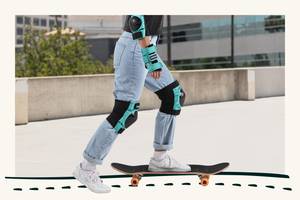
A good set of skateboard pads consists of a pair of elbow pads, knee pads, and wrist guards. Look for pads with soft EVA foam on the inside, durable plastic shells on the outside, and adjustable elastic to fine-tune the fit. Don’t forget a helmet!
How should skateboard pads fit?
Skateboard pads should be snug but comfortable. They should not restrict movement but stay firmly in place when you move around and not slide down the forearms or shin. The EVA foam padding should be positioned directly over the joints (knee, elbow, wrist). Remember to purchase the proper pads for your age—our pads come in three sizes: 3-9, 10-14, and 14+ (adult).
Do skateboard pads prevent breaks?
The best skateboard pads will definitely reduce your risk of broken bones and other injuries, particularly when learning to skate. Pads provide crucial cushioning and protection for your most vulnerable areas—knees, elbows, and wrists—absorbing impact during falls and reducing the force transmitted to your bones and joints. This can make the difference between a minor scrape and a serious fracture. However, no padding is guaranteed to prevent every break or injury. So, while your skateboard pads might not make you invincible, they will dramatically increase your chances of walking away from a fall unscathed.
Are hard or soft knee and elbow pads better?
The best padding differs from sport to sport, but for skateboarding pads, look for something with a hard external shell, such as ABS plastic, and a soft interior cushioned with something like EVA foam. The hard exterior will take the brunt of the blow and induce a “slide” to transfer the force of your fall, while the internal cushion will absorb the remaining force and help prevent discomfort.
Do you really need a helmet to skateboard?
While some skaters might forgo helmets, many skateparks enforce a legal requirement to wear a helmet. Regardless of the law, the best skateboard helmets are absolutely crucial for safety. Skateboarding is an action sport with inherent risks, and perhaps chief among those risks is the risk of a head injury. No matter how good of a skater you are, you will fall eventually, and when you do, your head is the place you want to protect the most. A helmet acts as a protective barrier for your noggin, absorbing impact and reducing the risk of concussions, skull fractures, brain bleeds, and other injuries. Even a seemingly minor fall can result in a head injury, and the consequences can be severe. A broken ankle or wrist can heal, but a broken skull can have life-changing (or ending) consequences. Protect your dome!
How to choose a skate helmet?
To find the perfect skate helmet, ensure a snug but comfortable fit that sits level, covering your forehead without obstructing vision. Look for a durable outer shell, impact-absorbing liner, and features like ventilation ports and adjustable straps. Finally, consider style and reviews to find a helmet that offers optimal comfort and fits your taste.
Should a skateboard helmet be tight?
A skateboard helmet should fit snugly but comfortably on your head. It shouldn't be so tight that it feels constricting or causes pressure points, but it shouldn't be so loose that it moves around or shifts position when you shake your head. A properly fitted helmet should sit level on your head, covering your forehead and not obstructing your vision. You should be able to fit one or two fingers between the helmet and your eyebrows. The straps should be adjusted so that they form a “V” shape around your ears, and the chin strap should be snug but not choking. Ultimately, the goal is to find a balance between a secure fit that keeps the helmet in place during impact and a comfortable fit that doesn't cause discomfort or distraction while skating.
Is a skateboard helmet the same as a bike helmet?
While skateboard helmets and bike helmets might look similar, there are some key distinctions in their design and safety standards. Skateboard helmets are designed to withstand multiple impacts from various angles, as falls in skateboarding are more routine and often involve rolling or hitting different parts of the head. They tend to have a thicker, harder outer shell and a more rounded shape to provide better protection for the back and sides of the head. Dedicated skateboard helmets should meet the American Society for Testing and Materials (ASTM) F1492 safety standards. Bike helmets, on the other hand, are primarily designed for a single, high-impact crash. They have a more aerodynamic shape, less overall coverage, and prioritize ventilation. Bike helmets are verified under a different standard, tested by the Consumer Product Safety Commission (CPSC).
Can you use a bike helmet for skating?
Although some bike helmets are styled more for skateboarding (like many of our helmets, such as Dakota) these helmets are, in truth, still bicycle helmets. Still, both skate helmets and bike helmets are designed to protect the head from impact, and the forces at play are similar. Most high-quality bicycle helmets will also provide reliable protection for skateboarding. One consideration, however, is protection at the base and rear of the head. Skateboarding helmets (and bike helmets made for mountain biking like Rowan) usually have extensive rear coverage, but some road cycling helmets don’t. Check your bike helmet to ensure it has full coverage before using it for skateboarding. The other consideration is how often you’ll be using your helmet. While most bike helmets can protect in the event of a single skate crash, true bike helmets are certified to protect against one high-impact crash, not repeated low-impact falls like those encountered while skateboarding. If you’re skateboarding regularly, it’s best to seek out a dedicated skateboard helmet that is certified to the American Society for Testing and Materials (ASTM) F1492 standard.
Why don't pro skateboarders wear helmets?
While skateboarding helmets are ubiquitous on ramps and bowls, they’re less common on flat ground. In the past, pro skateboarders often skipped helmets due to a combination of factors: a historical ‘rebellious’ image that clashes with safety gear, a sense of confidence in their skills, discomfort with helmet fit, and potential pressure from sponsors. However, this mindset is thankfully shifting, with many pros now advocating for helmet use, especially for beginners. While you might be used to seeing professional skaters leaving helmets behind, some of the very best, such as Tony Hawk and Andy Anderson, strongly advocate for the use of skateboard helmets. “I encourage people who are learning to skate to wear a helmet, because you never know what’s gonna happen,” Hawk said in a recent interview. “Protect your brain, bro. Your brain is you,” says Anderson. Ultimately, choosing to forgo a helmet is foolish, particularly while learning to ride. Even skilled skaters can experience falls and head injuries, and the consequences may be severe.


