


23.7K certified reviews
Bike Components
Round out your ride with spare parts to keep handy just in case.
Trusted By Our Loyal Customers

Free shipping over $35

Exceptional Value

Finance starting from $19/month
sort by:
Product Type:


From Our Gear Experts
Do all bike seats fit all bikes?
Not all bike seats fit all bikes. Seat post diameters vary. 27.2mm, 30.9mm, 31.6mm, and 34.9mm are all possible post diameters on modern U.S. bikes. However, all retrospec bike seats do fit all retrospec bikes! Our standalone seats, like Parker Comfort Commuter, Chatham Cruiser Comfort, and Harper Vintage Road Commuter, are all compatible with any retrospec bike.
How do I find the right bike seat for me?
Finding the right bike seat involves considering your body type and riding style. Consider the type of riding you do, such as casual cruising, urban commuting, road cycling, or mountain biking. Each discipline calls for a different saddle shape and padding level. Most likely, the bike you purchase for your riding style will already have a seat that suits the bike, so you won’t need to worry about mixing and matching bike seats. If you’re struggling to narrow your options, consider our “Help Me Choose a Bike” quiz. It’s free and only takes 30 seconds!
What is the difference between a bike seat and a bike saddle?
The terms bike seat and bike saddle are usually interchangeable, and in 99.9% of uses, you’re correct to use either. However, some cyclists draw a distinction. They argue that a seat is something you sit on with your entire weight, like when riding a beach cruiser bicycle, while a saddle is designed to support only part of your weight while riding, like on a road bike. This distinction is not universally agreed upon, though, and both terms are widely used to refer to the same thing: the part of a bicycle you sit on while riding.
Is a hard or soft bike seat better?
It depends on who you ask! Both hard and soft seats have pros and cons, but for the most part, it’s a matter of personal preference and riding style. Hard saddles—like those found on road bikes—are favored by experienced cyclists and those who ride longer distances. They provide a more stable platform, allowing for efficient pedaling and reduced friction. Your sit bones are designed to bear your weight, and a hard saddle allows them to do so directly, potentially reducing pressure on soft tissues. However, hard saddles require getting used to and may feel uncomfortable for shorter rides or casual cyclists.
Soft saddles, with their wider base and plush cushioning, offer immediate comfort and appeal to beginners. They provide relief on shorter rides or bumpy terrain. However, the extra padding can create pressure points and increase friction, leading to discomfort on longer rides. The sinking feeling can also hinder efficient pedaling and cause chafing.
Soft saddles, with their wider base and plush cushioning, offer immediate comfort and appeal to beginners. They provide relief on shorter rides or bumpy terrain. However, the extra padding can create pressure points and increase friction, leading to discomfort on longer rides. The sinking feeling can also hinder efficient pedaling and cause chafing.
How to sit on a bike so it doesn't hurt?
It starts with making sure your bike is sized properly. First, adjust your seat height so that your legs are almost fully extended at the bottom of each pedal stroke. Ensure the seat is level and positioned to allow a slight bend in your knee when the pedal is at the furthest point forward. Then, adjust your handlebar height and reach to distribute weight evenly and maintain a relaxed posture. In terms of how you “sit” on the bike saddle, remember that cycling is an active process. It’s not about sitting still; it's about engaging your core and using your body dynamically while you ride. Maintain a neutral spine, avoid slouching, and relax your shoulders. Don't hunch or tense up. Keeping your shoulders loose and your chest open allows for better breathing and upper body comfort.
As you ride, avoid staying in one position for too long. Shift your weight slightly every few minutes by subtly changing your hand position and how you sit on the saddle. This improves blood flow and reduces pain on your pressure points. As you ride, engage your hamstrings and glutes to help stabilize your body and take some pressure off your sit bones. Think of it like this: you're not just sitting on the saddle; you're actively participating in a dance with your bike. This dynamic interaction is key to both comfort and efficiency.
As you ride, avoid staying in one position for too long. Shift your weight slightly every few minutes by subtly changing your hand position and how you sit on the saddle. This improves blood flow and reduces pain on your pressure points. As you ride, engage your hamstrings and glutes to help stabilize your body and take some pressure off your sit bones. Think of it like this: you're not just sitting on the saddle; you're actively participating in a dance with your bike. This dynamic interaction is key to both comfort and efficiency.
What is the most comfy bike seat?
We mentioned this above in the “hard vs. soft” seat debate, but it really depends. A firm saddle is more comfortable for performance-focused bikes and long-distance riding. For short, casual riding, where you may be stopping and hopping on and off your bike often, a wide, plush saddle (like those found on our beach cruisers and city bikes) is more comfortable. The saddle's shape and width should complement your sit bone distance, providing proper support. Flexible saddles with some “give” can also enhance comfort by absorbing vibrations. You could also consider saddles with a center cutout (“noseless”) or channel to relieve pressure on sensitive areas.
Do noseless bike seats work?
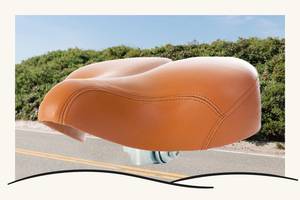
Noseless bike seats can offer some unique advantages. By removing the nose, these saddles eliminate pressure on sensitive areas, potentially improving blood flow and reducing numbness, especially for men. This can make them a good option for those experiencing discomfort or pain with traditional saddles. However, noseless saddles may require some adjustment to your riding position and pedaling technique. They often have a wider design to provide support, which can take time to get used to. Many riders also find they lack the same level of control and stability as traditional saddles, particularly during aggressive riding or hill climbing.
What is a wheelset on a bike?
A wheelset on a bike is a pair of wheels, consisting of the front and rear wheels. This includes the hubs, spokes, rims, and tires. It is what allows the bike to roll and move.
Do all bike wheels fit all bikes?
Unfortunately, not all bike wheels fit all bikes. There are several factors that determine wheel compatibility, making it crucial to choose the right ones for your bike. The most important is wheel size, which is typically measured in inches or millimeters. Using the wrong wheel size can affect handling and stability and may damage your bike. The most common size is 700c, which is used for almost all road bikes. 26”, 27.5”, and 29” are common sizes for mountain bikes, and there are various other sizes for BMX bikes, ebikes, beach cruisers, and kids bikes. Beyond size, you must also consider axle type, hub width, and brake compatibility. Axles come in different diameters and lengths, and the hub spacing needs to match your bike's frame and fork. Additionally, if your bike has disc brakes, the rotors need to align with the brake calipers, and if you have rim brakes, the rims must be compatible with the brake pads.
What does 700c mean for bike wheels?
Good question! For starters, let’s address a common misconception. 700c and 700cc are two different things. Cubic centimeters (cc’s) are a motorcycle power metric. 700c, on the other hand, is a size for road bike wheels. The “700” indicates the maximum outside diameter of the wheelset and the “c” indicates the width of the tire. Contrary to what you might think, the “c” does not refer to centimeters. The “c” comes from an old French measurement system, which runs from “a” to “d,” with the former being the narrowest tires, the latter the widest. Today, almost all road bike manufacturers use 700c wheels, so a 700c wheelset like our Harper Plus Wheelset can fit any road bike.
How do I know what rims will fit my bike?
Finding the right rims for your bike requires matching a few key specifications. First, check your current tire sidewall for the wheel diameter, which is usually listed in inches or millimeters. This number indicates the rim size you need. Next, determine your axle type (quick-release or thru-axle) and measure its diameter and length. For the rear wheel, you'll also need to know the hub spacing (e.g., 135mm, 142mm) and ensure the new rim is compatible with your cassette. Finally, consider your brake type (rim or disc) and ensure the rim is designed to work with your brakes. If you're unsure about any of these measurements, your bike’s owner's manual or a local bike shop can help you identify the correct rim specifications.
Do lighter bicycle wheels make a difference?
Lighter bicycle wheels make a difference by improving acceleration, handling, and uphill ability. The lighter the wheel, the more agile and responsive the bike will feel, due to reduced rotational inertia and overall weight. However, there are drawbacks. Thin, lightweight wheels are a great choice for road bikes that will primarily be ridden on smooth surfaces but are less helpful for other bike styles. For one, they generally transmit more vibrations to the rider, resulting in a harsher ride on rough surfaces. They also aren’t as heavily lugged, so won’t have good traction on dirt, gravel, and other uneven surfaces. Thinner, lighter tires are also more susceptible to punctures and may have poorer handling in corners. Consider if the performance gains outweigh the investment, especially if you're a casual rider or plan to ride on varied surfaces. If you prioritize speed and mainly ride on smooth surfaces, lighter wheels might be a worthwhile upgrade.
What is a flip flop wheelset?
A flip flop wheelset has a hub with threads on both sides, allowing you to install a fixed gear cog on one side and a freewheel on the other. This means you can switch between a fixed-gear (fixie) setup, where the pedals are always moving with the wheel, and a single-speed setup, where you can coast, simply by flipping the rear wheel. This versatility makes flip flop wheelsets popular for track bikes and urban riding. For more on flip flop wheelsets, see the FAQs on our Single Speed & Fixie Bikes collection page.
How many miles should a wheelset last?
The lifespan of a wheelset can vary greatly depending on factors such as the quality of the wheels, the rider's weight, riding style, terrain, and maintenance. On average, a well-maintained, high-quality wheelset can last anywhere from 5,000 to 10,000 miles or more. It's important to regularly inspect your wheels for any signs of wear and tear, like cracks, dents, or loose spokes, to ensure their longevity and safety.
How do I know what grips fit my bike?
Most bike grips are designed to fit a handlebar diameter of 22.2mm (7/8 inch) with a grip length of 120mm. This is the “standard size” for most bikes, from mountain bikes and city bikes to road bikes and hybrid bikes. However, some bikes may have different dimensions. To ensure you purchase the right size grips, use a ruler or measuring tape to measure the diameter of your handlebars and check the grip specifications to match. Keep in mind that grips will have both an “installed diameter” (the outer diameter of the grip) and an internal diameter (usually 22.2mm), which is the diameter of your handlebar, the surface the grip needs to fit around.
Are bike grips one size fits all?
No, bike grips are not one size fits all. While many bike grips are designed to fit a standard handlebar diameter (usually around 22.2mm—see above), they are not truly one-size-fits-all. Some bikes may have different handlebar dimensions.
What material is best for bike grips?
Bike grips can be made from rubber, silicone, foam, and even leather. Rubber grips are a popular choice, offering a good balance of grip, durability, and affordability. Silicone grips are known for their excellent vibration damping and wet-weather grip but can be more expensive. Foam grips provide exceptional comfort and shock absorption but may wear down faster. Leather has few “functional” benefits but is quite durable and offers a vintage aesthetic that some riders appreciate.
What is the point of handlebar pads?
A handlebar pad, or “crossbar” pad, is a protective layer of padding placed across the center of a bike’s handlebars, between the grips. Originally, this padding was designed to protect riders in aggressive disciplines like BMX, where falls and impacts are common. (The padding helps cushion the blow if the rider collides with the handlebars.) On a beach cruiser, handlebar pads are primarily a cosmetic choice, adding a laid-back, retro aesthetic. However, they also provide a layer of comfort, making it more pleasant to lean on or rest against the handlebars during casual rides.
When should I replace my bike grips?
You should consider replacing your bike grips if you notice visible wear and tear such as cracks, tears, or worn-down areas, reduced grip, discomfort or pain in your hands during rides, or a sticky or tacky feel due to sweat, dirt, and exposure to the elements. You can also replace your grips if you simply want to upgrade to a different style!
How do you remove and replace bike grips?
You can use a few different methods to remove old bike grips. For lock-on grips, simply loosen the bolts with a hex key and slide them off. For slide-on grips, you can try twisting and pulling them off or use a lubricant like compressed air or rubbing alcohol to loosen them. If they're stubborn, you can carefully cut them off with a razor blade or pocket knife. To install new slip-on grips, clean the handlebars with rubbing alcohol, spray a lubricant like hairspray or soap and water inside the grips, and slide them onto the handlebars. For lock-on grips, align them on the handlebars, tighten the bolts with a hex key, and ensure they're secure.
How to keep bicycle handlebar grips from slipping?
Slipping grips can be a real nuisance. Luckily, there are several ways to keep those grips firmly in place. First, make sure your grips are the correct size for your handlebars. If so, one of the simplest tricks to fix slipping grips is to coat the handlebar in hairspray. The sticky residue helps create friction between the grip and the handlebar. Another option is to use grip glue, which is specifically designed for this purpose. If your grips are already installed and starting to slip, try cleaning the handlebars thoroughly with rubbing alcohol to remove any dirt or oil buildup. You can also try lightly sanding the inside of the grips to create a rougher surface for better adhesion.


